The signs you need a water softener in a Columbia, SC home are usually small and everyday: a chalky crust on faucets and shower heads, cloudy spots on glasses, soap that won't lather, and water heater or toilet parts that wear out sooner than they should. None of them prove your water is hard on their own. Hardness varies by address and by water source, so the only way to know is to test. Here's what to look for, how a softener helps, and how to decide.
What makes water hard
Hard water carries more dissolved calcium and magnesium. The minerals stay dissolved until heat or evaporation pulls them out as scale. The U.S. Geological Survey classifies water by its calcium carbonate content: 0 to 60 milligrams per liter is soft, 61 to 120 moderately hard, 121 to 180 hard, and over 180 very hard.
City water and well water are different
Most homes in Columbia are on municipal water, while some properties on the edges of the metro use private wells. Well water picks up whatever minerals are in the ground it passes through, so two homes a few miles apart can test very differently. Municipal treatment isn't designed to soften water, so any hardness in the source generally reaches your taps. See city water vs. well water.
The damage is quiet
Scale forms inside pipes, the water heater and appliances long before anything shows on the outside. By the time pressure drops or the water heater struggles, it has usually been building for years.
Signs to look for
Skin, hair and laundry
- Skin that feels tight or dry after a shower
- Hair that feels coated or won't lather
- Towels and clothes that feel stiff
- Needing more soap or detergent than the label suggests
These creep up slowly, and most households work around them with stronger products before anyone suspects the water.
Fixtures and glass
- White, chalky buildup around faucet bases, aerators and shower heads
- Spotty glasses straight out of the dishwasher
- Shower doors that film over again within days of cleaning
- Faucet cartridges and toilet parts that wear out early. See faucet cartridge repair.
Pipes and appliances
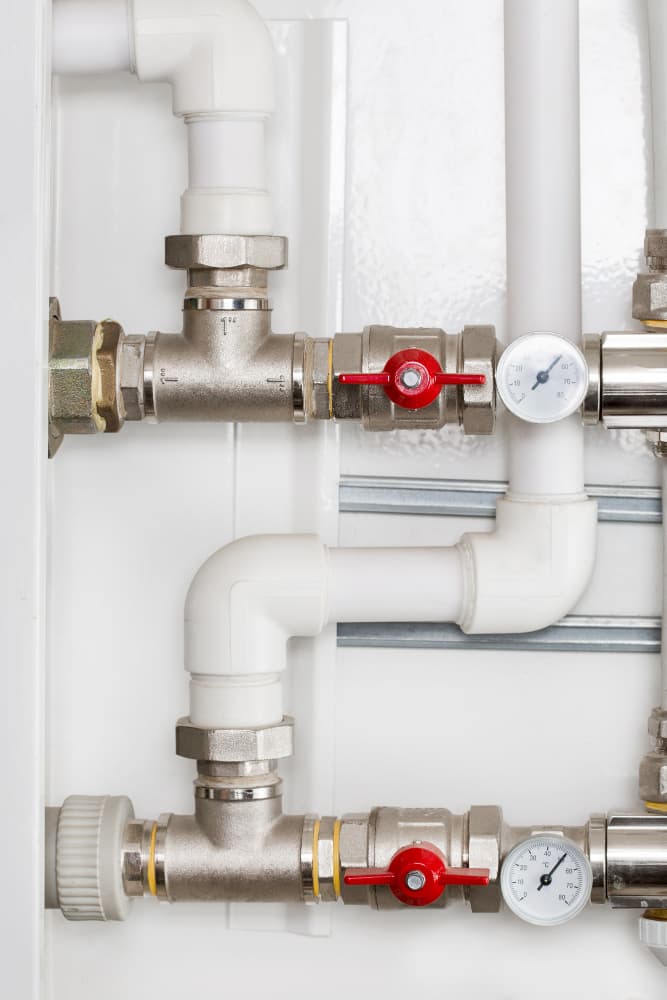
This is where scale gets expensive. In a water heater, minerals settle at the bottom of the tank, insulate the water from the heat, make the unit work harder and speed up corrosion. In pipes, scale narrows the inside and reduces flow over time.
- A water heater that rumbles or pops
- Hot water taking longer to arrive
- Pressure dropping slowly at several fixtures
- Dishwashers and washing machines needing repairs sooner than expected
Read more on how mineral buildup affects plumbing.
What a softener fixes
How it works
A softener uses ion exchange. Water passes through resin beads that swap calcium and magnesium for sodium, which doesn't form scale. When the resin is full, the system rinses itself with brine on a schedule and sends the collected minerals down the drain. You keep the salt topped up.
What changes
- Less scale on fixtures, shower heads and glass
- Soap and detergent working with less product
- Less scale inside the water heater, whether you have a tank or a tankless unit
- More consistent flow as pipes stop narrowing
A softener is not a filter
A softener removes hardness minerals. It doesn't remove chlorine taste, sediment or other contaminants. That's a filter's job, and some homes run both. Our guide to water filtration vs. water softeners explains the difference, and our water filtration page covers filter options.
Before you install one
Test first, then size
Softeners are sized by grain capacity, matched to your household's water use and the measured hardness. A unit that's too small regenerates constantly and wears out early. A test gives the number to size from.
- Household size and daily water use
- Measured hardness, in grains per gallon
- Peak demand, like back-to-back morning showers
- Whether a filter will share the same line
Where it goes
A softener is installed on the main line where water enters the house, usually in a garage, utility room or crawl space access, with a drain nearby for the rinse cycle and an outlet if the control head is powered. Some homeowners leave an outdoor spigot on unsoftened water for the garden. We'll look at your setup and suggest the simplest location before we quote.
Maintenance
- Check and top up the salt, roughly monthly
- Break up any salt crust in the brine tank
- Confirm the regeneration schedule is right
- Retest hardness now and then to confirm it's keeping up
What affects the price
Household size, hardness level, how easily the main line can be reached, and whether a filter is added at the same time. We give you the price before work starts, and 0% financing is available on bigger jobs.
Our water softener installation team sizes and installs systems across Columbia, Forest Acres, Irmo and the rest of the Midlands. Water heaters suffer most from scale, so if yours is struggling, see water heater repair too.
Water softener FAQs
Is Columbia's water hard?
It depends on your address and water source. Test your water before buying a softener.
Is hard water bad for my health?
Hard water is generally not a health concern. It's a nuisance that wears on plumbing, fixtures and appliances.
Will a softener help my water heater last longer?
Reducing scale reduces one of the main causes of water heater wear, for both tank and tankless units.
Do I need a softener and a filter?
Only if you have both hardness and another issue, like chlorine taste or sediment. A test shows which.
Seeing signs of hard water in the Columbia area? Call Dr Rooter Lexington at (803) 761-9935.